

Bahrain runs more of its economy on electricity than the United States does. China still made almost sixty per cent of its electricity from fossil fuels in 2025. Norway’s wealth rests on exporting oil and gas. Pakistan electrified largely by accident. So which of them is an electrostate?
From petrostate to electrostate
To understand what an electrostate is it helps to go back to where the word originally came from. Electrostate comes from petrostate. A petrostate is a country whose public finances, politics and economy depend significantly on extracting oil and gas and selling them abroad. Political scientists have tried to use quantitative metrics to define them more clearly: oil and gas revenues worth at least a tenth of GDP, or more than a third of government revenue or exports. Countries such as Saudi Arabia, Russia and Nigeria are the textbook cases.
But to really get a sense of what a petrostate is these numbers alone are not sufficient. Terry Lynn Karl’s study of oil booms, The Paradox of Plenty, showed how oil revenue shapes the political economy of a country. Governments in those countries can fund the public budget from oil revenues and need to collect less tax, which comes with less accountability to citizens. Power and wealth concentrate in the state and around those with access to the oil revenue. Because oil and gas offer a steady stream of revenues the rest of the economy is less diversified compared to countries without significant oil and gas reserves. The problem is that when energy prices fall and demand shrinks the arrangement suddenly gets challenged.
The electrostate is usually presented as the opposite of a petrostate. The word is only a few years old and was coined by Kingsmill Bond and his team at the think tank Ember. It has since spread after being popularised by outlets such as the Financial Times and Forbes. Despite its increasing usage it is rarely defined. When you read the various reports and articles at least four different dimensions emerge.
Four dimensions
The first is simply descriptive. An electrostate is a country where a large share of final energy is electricity (an even better metric is how much useful energy it provides but data is currently not available on a consistent basis). Take Norway for example: close to half of its final energy use is electricity. Japan, at just above thirty per cent, ranks ahead of the United States and most of Europe. Noah Gordon and Daevan Mangalmurti of the Carnegie Endowment for International Peace call these countries ‘consumer electrostates’. This reading does not tell you much about why or how this outcome was achieved. It also says nothing about where the electricity comes from. Bangladesh has overtaken the United States and Europe on electricity’s share of final energy, yet nearly all of its power is generated from fossil fuels. An even more extreme case is Bahrain, where more than forty per cent of final energy demand is electric but almost all of the electricity comes from fossil fuels.
The second dimension includes the supply side and is about energy security. An electrostate is a country that not only uses a lot of electricity but generates most of it from its own resources including solar, wind, hydro and nuclear (although some people would flag that nuclear requires a steady stream of fuel too). Because of this countries rely much less on buying fossil fuels from abroad. Importantly I exclude electricity from domestically extracted fossil fuels here as in the literature about electrostates nobody argues that countries with a lot of coal generation qualify. Let’s take Norway: it passes this test easily, because almost all of its electricity comes from domestic renewables - mostly hydro power. That can happen with very little planning. Pakistan is such a case. Millions of households and businesses put solar panels on their roofs because the grid had become too expensive and too unreliable to depend on, even though there was little policy to drive this. In doing so they reduced the country’s need for imported fuel. Wajid Islam, Asha Amirali and I tell that story in a paper forthcoming shortly in the journal Energy Research & Social Science. China is a fairly weak case under this dimension - despite being the largest renewable electricity producer in the world by a wide margin, it still produced almost sixty per cent of its electricity from fossil fuels in 2025, although that is declining steadily and emissions appear to have now peaked.
The third dimension focuses more on the word ‘state’. An electrostate is a country whose government has decided to electrify its economy on purpose. It has an industrial policy focused on electrification and sets targets for how much of the economy should run on electricity, changes taxes and prices so that electricity can compete with fossil fuels, and builds the grids to transport it. This is the sense in which China is called the first electrostate. But Pakistan fails this test: there was no strategy behind its solar boom.
For a long time China was almost alone in thinking this way. That is now changing, and quickly. In the months after the Strait of Hormuz closed, three major economies published electrification strategies. In April the French government presented a plan of 22 measures to electrify its economy. France aims to raise electricity’s share of final energy from 27 per cent to 38 per cent by 2035. In May, Canada published Powering Canada Strong, a national strategy for an electrified Canadian economy that aims to double the country’s electricity supply by 2050. And in July the European Commission published its Electrification Action Plan. It sets an indicative target of doubling the share of electricity of EU final energy consumption from 23 per cent today to 46 per cent by 2040. At the launch it was framed as the plan to make Europe the first electrocontinent.
What is striking is how little of this is framed as climate policy: the French plan leads with energy independence, the Canadian strategy with economic growth and the European one with competitiveness. Of course, having a plan is not the same as delivering on it and I have been sceptical of being too focused on targets in the past knowing that they are often quietly missed. The European target is indicative rather than binding. None of the proposed strategies have yet been tested against an election or a recession. But governments that a few years ago treated electrification as one climate measure among many are now treating it as a serious economic strategy and industrial policy.
The fourth dimension is about manufacturing. Gordon and Mangalmurti call these ‘producer electrostates’: countries that make the batteries, panels, cables, heat pumps and electric vehicles that electrification needs, and sell them abroad. China is once again the obvious case, but not the only one. South Korea’s three big battery makers supply carmakers from Tesla and Volkswagen to BMW, and hold more than a third of the electric-vehicle battery market outside China. Under this dimension Norway looks much less like an electrostate because most of the technology deployed in Norway is imported from overseas. Its economy and its sovereign wealth still rest on exporting oil and gas.
What I mean by electrostate
Below I made an attempt to score six very different countries against each dimension. Note that this is illustrative only and I invite feedback which other and better metrics we ought to use. But I find it helps to be more precise when we use the term and when we decide which countries get the label and which do not.
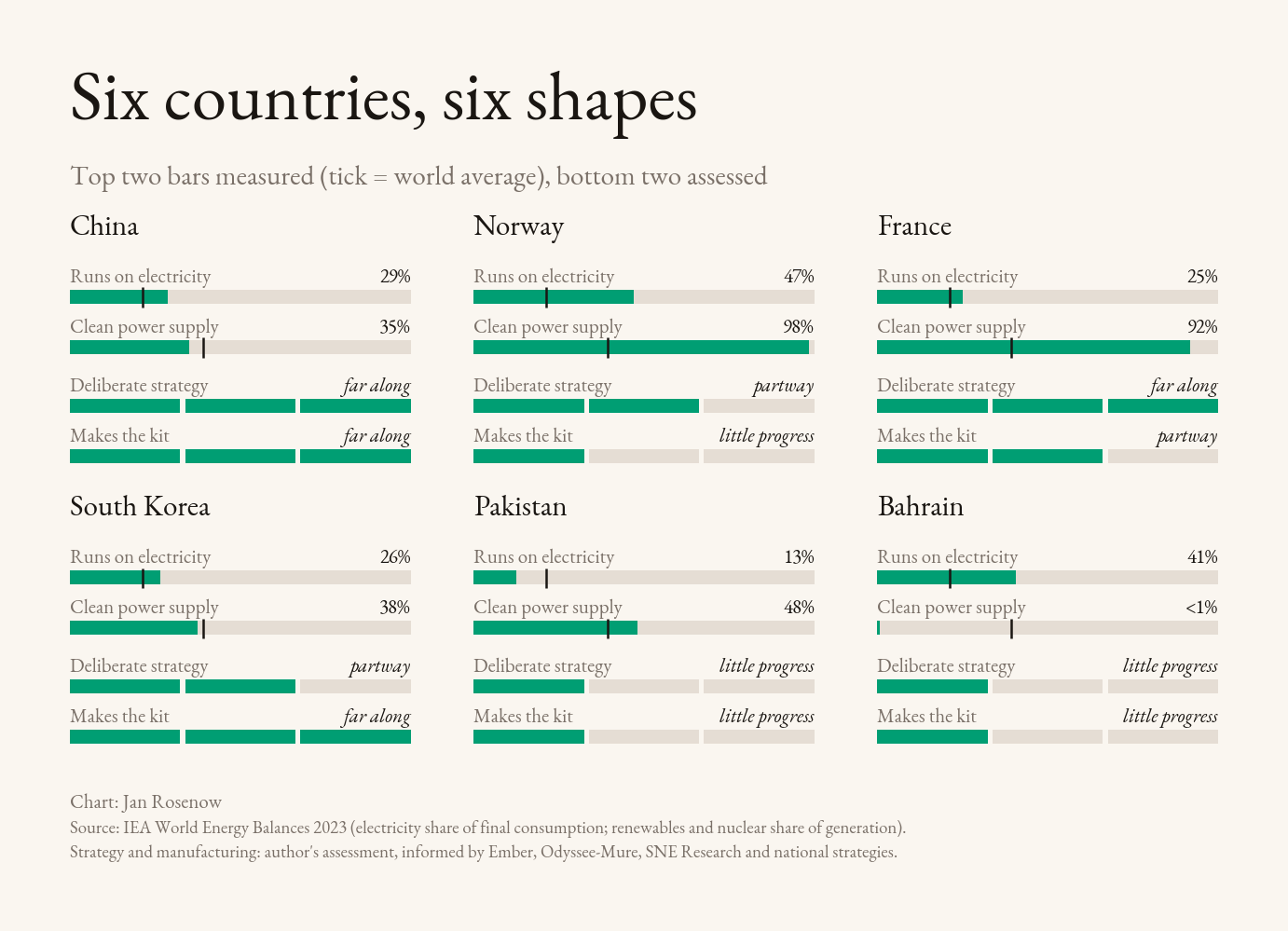
When I use the word electrostate, I mean a country that is moving along all four lines, even if not at the same speed. Its economy runs increasingly on electricity. Much of that electricity comes from its own solar, wind, water or nuclear generation. Its government treats electrification as a matter of industrial and national strategy rather than of climate policy alone. And it makes at least some of the equipment that electrification needs, whether for its own use or for export. Today only China is far along all four. But being an electrostate is not a club a country is either in or out of. It is a direction of travel, and some countries are much further along it than others.
The neat division into petrostates and electrostates is elegant but also inaccurate. The reality is much messier and countries may be far along in any one or several of those four dimensions but lag behind in others. Electrostates are also not inherently ‘better’ when it comes to other aspects of institutions and decision making. Powerful incumbents do not disappear overnight and new ones are created. And new dependencies, on processed minerals or on one country’s equipment, replace some of the old ones. Importantly, a dependency on equipment you buy once is a different thing from a dependency on fuel you buy every month. I will come back to the new dependencies in a future issue.