

In the summer of 2025, solar became Pakistan’s single largest source of electricity, generating around a quarter of the country’s power during peak months. A decade earlier, solar was contributing less than 1 percent to electricity generation in Pakistan. This was not driven by a major subsidy program. People and businesses largely did it themselves in response to unreliable and expensive electricity.
Pakistan is probably the most dramatic and most well-known case of a bottom-up solar revolution, but it is not unique, and versions of the same story are unfolding across the world right now: Countries with hot climates, fast-growing economies, expensive energy, and fragile grids are the ones that increasingly turn to solar. Not because of policy, but because people and businesses vote with their feet.
The scale of this shift is already visible in the data. Across six countries — Pakistan, Nigeria, Lebanon, Sri Lanka, Zambia, and Yemen — recorded solar generation has grown more than sixfold since 2019, though Pakistan accounts for most of that increase. In Pakistan, Lebanon and Sri Lanka, solar’s share of the electricity mix has risen steeply: Pakistan from 2 percent to over 20 percent, Lebanon from under 1 percent to around 30 percent. Elsewhere the shift barely shows up in generation statistics at all, because the panels are off-grid and unmetered. Nigeria’s recorded solar share is still a third of one percent.
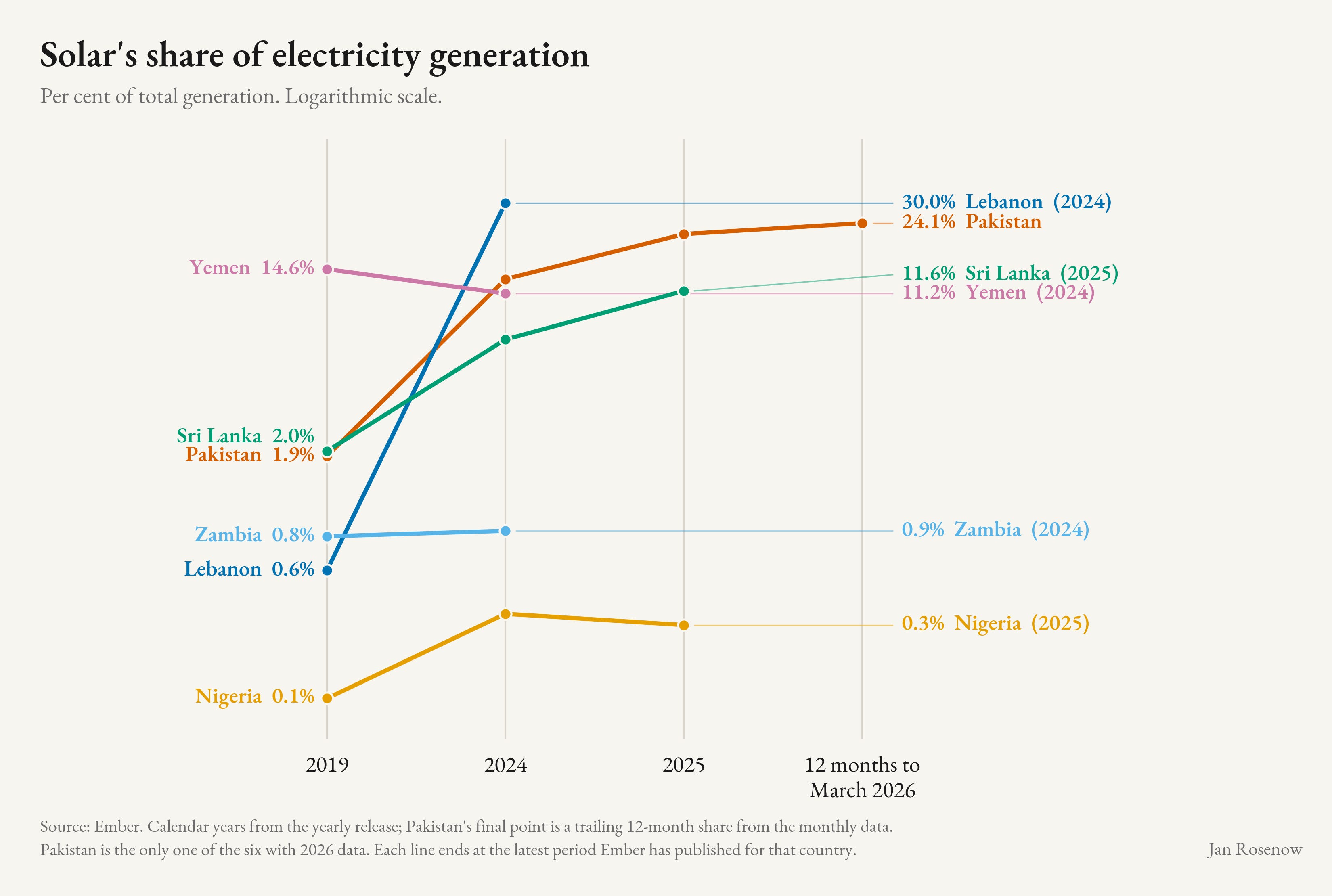
That matters far beyond these countries, because most of the world’s future growth in electricity demand will come from emerging and developing economies. But while Pakistan’s rapid, bottom-up solar shift offers a hopeful model for other countries, it also offers a warning. The proliferation of household solar has led to an exodus from Pakistan’s national grid, rattling the network while saddling the poorest ratepayers with higher bills and left with an unreliable grid. Similar dynamics are at play in Nigeria and Zambia. These countries are facing a boom and a crisis at the same time.
The challenge is clear: Solar power can be a liberatory force in developing countries, offering a new source of cheap electricity in places long starved of energy, but if governments fail to manage the transition well, the coming buildout could weaken already creaky power systems and worsen inequality.
The invisible solar revolution
The scale of this is unprecedented. Pakistan has imported more than 51 gigawatts of solar panels since 2020. For comparison: the average coal power plant has around 1 gigawatt capacity. So on paper 51 gigawatts of solar is the equivalent of about 50 coal plants. In practice, solar panels only run at full output around midday on sunny days, while a coal plant can run day and night, so over a year the panels generate much less electricity. Even so, 51 gigawatts of solar produces roughly as much power as a dozen large coal plants put together. This makes Pakistan the stand-out country, but the same story repeats itself elsewhere.
Between 2020 and 2025, Nigeria imported more than 5.5 gigawatts of solar panels, close to the most power its national grid has ever supplied at any one moment, and is today Africa’s second-largest solar market behind South Africa. In Lebanon, recorded solar capacity rose roughly tenfold between 2020 and 2024. Sri Lanka reports that rooftop solar capacity grew more than sixfold between 2020 and 2025, with the country now boasting more than 129,000 rooftop systems. And in Yemen, more than half of all people now rely on solar as their main source of electricity for lighting.
What is remarkable is that much of this does not appear in official statistics because the installations are overwhelmingly distributed, behind the meter, and often not officially registered. In Nigeria, an estimated 96 percent of solar capacity is off-grid. These are private mini-grids, rooftop arrays, and solar home systems deployed in underserved areas. In Pakistan, official statistics capture only grid-connected, net-metered, and utility-scale installations. This means as much as three-quarters of the country’s actual solar deployment may never be recorded. Because of that, analysts have increasingly turned to customs records, Chinese export data, and even satellite imagery to reconstruct what is really happening on the ground.
Leapfrogging to solar
What we see happening in these places is called “leapfrogging.” Countries are adopting new energy technology without first going through the same stages of fossil-fuel development as wealthier countries did in the past. It happens when three conditions are met: The new technology is already proven in mature markets. It offers better or comparable functionality to the incumbent technology. And it provides a way around expensive or dysfunctional infrastructure.
All three conditions are met for solar:
It is now a mature technology with established supply chains around the world, with China playing a central role in panel exports. Prices have also collapsed. Chinese manufacturers have built far more factory capacity than the world currently needs, and with tariffs keeping many of those panels out of markets such as the United States and India, much of the surplus has ended up in places like Pakistan and Nigeria instead.
In countries with rickety power grids, solar can offer more reliable electricity, especially when coupled with batteries. In Pakistan the grid is often poor, and in the worst-served districts, households can face 16 to 24 hours of outages in a single day. Since 2010, Nigeria has recorded at least 222 partial and total grid collapses, while around 40 percent of its population has no grid connection or access to electricity at all. In Yemen, the World Bank found that damage to the power system from the civil war had left just 10 percent of the population with access to the grid.
Solar also offers a workaround for expensive grid electricity. In Pakistan, the national average tariff almost tripled over the last decade, as subsidies were withdrawn, imported fuel costs surged after Russia’s invasion of Ukraine, and consumers were left paying capacity charges for underused power plants. There are parallels elsewhere. In Nigeria, electricity prices for some consumers increased by over 240 percent in April 2024 following tariff reform. In 2022, Lebanon’s state power company, Electricite du Liban, raised the price it charged for electricity for the first time since the 1990s. That year, the cost of household utilities, including electricity, was reported to have increased by 445 percent. The most extreme case of rising grid electricity prices is perhaps Yemen: In July 2026 the government approved increasing tariffs 36-fold.
The utility death spiral
Climate campaigners have celebrated the solar boom underway in emerging economies. But the rapid growth of solar can also create problems if it is unmanaged. Power grids have large fixed costs: Networks must be maintained while generating capacity has to remain available even when customers buy less electricity. When households and businesses that can afford solar panels cut their electricity consumption from the grid, utilities lose revenue. The result can be a vicious circle: Fixed costs are spread across a smaller number of units of electricity sold. As a result, tariffs rise, which in turn makes solar even more attractive. That leads to more customers defecting from the grid, and the cycle starts again. This is the famous “utility death spiral.”
Pakistan is already showing signs of this happening as our new paper in Energy Research & Social Science shows. Grid electricity sales fell 10 percent in a single year, and the energy minister has warned that falling demand risks making grid electricity increasingly unaffordable. The distributional consequences are potentially stark. Wealthier households and businesses can afford the upfront cost of panels and batteries and insulate themselves from rising prices. But poorer households cannot. If tariffs are raised to recover the grid’s costs, those unable to invest in solar can end up paying more for electricity. What is a profoundly democratising technology can ultimately worsen inequality when it is adopted into an already dysfunctional electricity system. What makes perfect economic sense for an individual household can make the collective system harder to finance.
Some solar customers may only partly exit the system, which can make the arithmetic worse. In Pakistan, many solar owners sharply reduce grid consumption during daylight hours but still rely on the grid after sunset. The grid therefore has to remain capable of meeting the evening peak even as it sells far fewer units during the day. In effect, those still on the grid are paying to keep power plants on standby through the day so they are ready once the sun goes down. And because many Pakistani plants are paid for their capacity whether they run or not, that bill falls on a shrinking pool of customers.
Counting what nobody records
None of this is an argument against solar. Quite the opposite. Installing solar in countries with hot climates, growing economies, and unreliable grids generates huge benefits for the economy, health, and education. Solar pumps let farmers irrigate their fields without paying for diesel. Swapping diesel generators for solar panels and batteries also means cleaner air. In countries like Nigeria, where millions of homes and businesses rely on diesel for their power this is particularly important.
An important task for governments and international agencies is to bring distributed solar into official energy statistics, using import data, registration and, where necessary, satellite monitoring. Think tanks such as Ember and Pakistan’s Renewables First are already piecing this picture together from trade and customs data. Governments need it for planning. More solar power means less need to conventional power generation but also more flexibility, more storage and smarter tariffs.
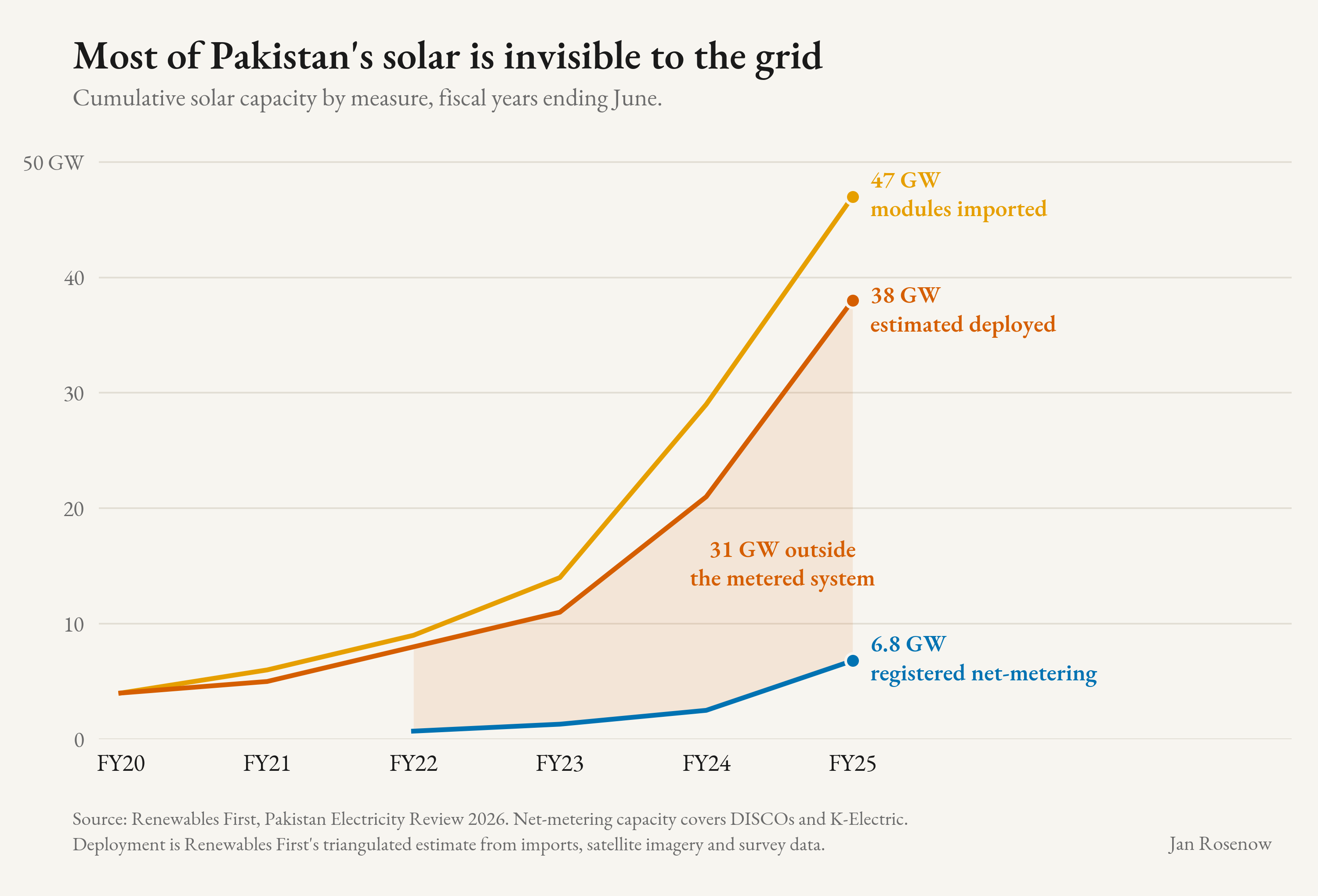
The more difficult challenge is to integrate fast-growing solar capacity into the existing grid and to do this in such a way that it strengthens rather than undermines it. Storage, smart meters, and more flexible networks can help do that. Batteries can store cheap solar during the day for the evening. This in turn reduces how much the grid has to supply after dark. More flexible networks can move surplus rooftop power to where it is needed instead of wasting it. Financing mechanisms and targeted support for low-income households can extend access so solar becomes affordable for more people, not just those who can already afford to leave.
Why isn’t this happening already? Many utilities in these countries are deeply in debt (Pakistan’s power sector alone has accumulated billions of dollars of so-called circular debt). This leaves little financial resources for batteries, meters, or network upgrades. Regulation has also struggled to keep up, since the rules on tariffs, net metering, and grid connections were written for a system built around large power plants rather than millions of rooftops.
The choice ahead
Lebanon offers a glimpse of the choice ahead. Its extraordinary solar boom may have begun to plateau. With a new government in place and a $250 million World Bank loan to build solar farms, modernize the state utility’s billing, and set up a national control center to manage the network, the country has an opportunity to integrate thousands of decentralised systems into a functioning grid. That would mean registering rooftop systems, paying their owners a fair price for surplus power, and using that solar to cut the utility’s costly fuel imports. Nigeria risks following the same path as Pakistan, with an even weaker distribution sector to manage the consequences. Its 2024 tariff increase fell on so-called Band A customers, who are promised at least 20 hours of power a day. These are the businesses and better-off households best placed to switch to solar, and the customers whose bills the struggling distribution companies rely on most.
The problem is not the technology itself. The key challenge is that the existing power infrastructure and the institutions running it in many developing countries are struggling to keep pace with the energy transition. The choice for governments is between letting distributed solar become an unmanaged exit from the grid or making it part of a more flexible and reliable system. A managed transition can ensure that the solar boom strengthens the electricity system and protects those who cannot afford to leave it behind.
An earlier version of this article was published on Yale Environment 360.